How to Wash a Doormat: A Guide to Proper Cleaning and Drying
How to Wash Mats: A Guide to Proper Cleaning and Drying
Mats, being one of the most frequently soiled textile products at home, should be cleaned regularly due to dust, hair, moisture, soap residue, and daily use. However, washing a mat at the wrong temperature or with the wrong program can cause its texture to harden, its color to fade, or its non-slip backing to get damaged.
So, how do you wash a mat, which washing machine program should be used, and at what temperature should mats be cleaned? In this guide, you will find step-by-step methods for properly cleaning cotton, microfiber, non-slip, and bath mats.
What to Consider Before Washing a Mat?
Instead of throwing the mat directly into the washing machine, a few simple preparations will ensure more effective cleaning and help protect the washing machine.
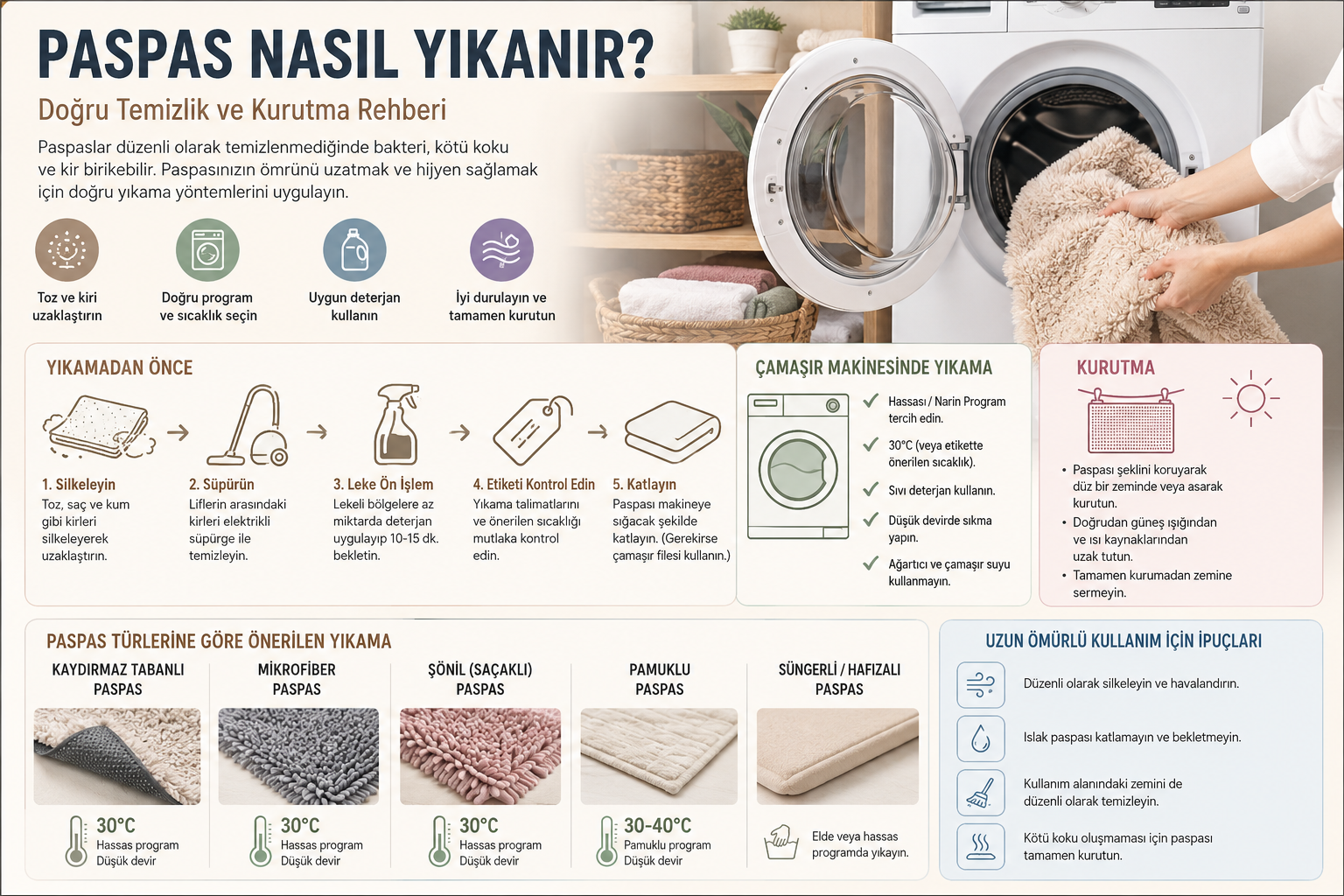
Before washing, follow these steps:
-
Check the care label.
The care label indicates whether the mat is suitable for machine washing, the recommended temperature, and the drying method. -
Shake the mat outdoors.
Remove as much hair, dust, sand, and surface dirt as possible. -
Clean with a vacuum cleaner.
Especially for long-pile or densely woven mats, vacuuming at low or medium power can remove dirt between the fibers. -
Pre-treat stains.
You can apply a small amount of liquid detergent to prominent stains and let it sit for about 10-15 minutes. Avoid soaking the product in bleach. -
Check the non-slip backing.
If the backing has cracks, peeling, or stickiness, hand cleaning may be preferable instead of machine washing.
How to Wash a Mat in the Washing Machine?
Machine-washable mats should generally be cleaned at a low temperature and with a delicate program. For the most accurate setting, always refer to the product's care label.
Generally, the following method can be applied:
- Wash the mat separately from other clothes and home textiles.
- Do not overload the washing machine.
- Select one of the delicate, gentle, or synthetic programs.
- Use liquid detergent.
- Spin at a low speed.
- Avoid very high temperatures and intense spin programs.
It is important for the mat to move balanced inside the machine. Very large or heavy mats can exceed the machine's capacity when wet. It may be safer to have such products cleaned by a professional cleaning service.
At What Temperature Should Mats Be Washed?
The answer to the question "At what temperature should mats be washed?" varies depending on the product's material and backing structure. For most bath and household mats, 30°C is a safe starting temperature.
Unless the care label permits a different temperature, the following temperature recommendations can be considered:
- Non-slip mats: Usually 30°C
- Microfiber mats: Usually 30°C
- Chenille mats: 30°C and delicate program
- Cotton mats: Depending on the care label, 30°C or 40°C
- Memory foam mats: Hand wash or delicate program according to product instructions
High temperatures, especially for rubber or latex-backed mats, can harden, crack, or reduce the non-slip properties of the backing. Instead of increasing the temperature for hygiene purposes, the highest temperature permitted by the product should be chosen.
How to Wash Bath Mats?
Bath mats are constantly exposed to moisture, water, and soap residue. Therefore, regular washing and complete drying are crucial to prevent bad odors and moisture buildup.
To clean a bath mat:
- First, shake it thoroughly and remove hair.
- If the label states machine washable, wash the mat alone.
- Choose a 30°C delicate program.
- Use a small amount of liquid detergent.
- Select a low spin speed.
- Remove the mat from the machine immediately after washing.
- Dry completely on a flat surface or in a well-ventilated area.
Returning a damp bath mat to the bathroom can quickly lead to the re-emergence of unpleasant odors.
How to Wash Non-Slip Mats?
The most delicate part of non-slip mats is the backing. High temperatures, strong chemicals, and hot air in the dryer can damage the backing structure.
When washing non-slip mats, the following points should be considered:
- Use the temperature specified on the care label at most.
- Generally, choose a 30°C delicate program.
- Do not use bleach or strong bleaches.
- Do not spin at high speed.
- Do not dry on radiators, stoves, or under intense sunlight.
- Only use a dryer if the care label permits it.
If the backing has started to peel or crack, machine washing can exacerbate the damage. In such cases, it may be better to superficially clean the mat with a damp cloth and an appropriate cleaner.
How to Wash Cotton Mats?
Cotton mats are frequently used products due to their absorbent and natural properties. However, high temperatures can cause cotton products to shrink, fade, and lose their shape.
Wash cotton mats with similar colors and at the temperature indicated on the care label. For colored cotton mats, color-preserving liquid detergent can be used. A low spin speed should be preferred to maintain the product's shape.
Washing fringed cotton mats with other laundry can cause the fringes to tangle. Therefore, if possible, wash the mat alone or with items of similar structure.
How to Wash Microfiber and Chenille Mats?
Microfiber and chenille mats stand out with their soft textures and high absorbency. For these products, low temperature and gentle washing are important to preserve the fiber structure.
When washing microfiber or chenille mats:
- Use a 30°C delicate program.
- Add a small amount of liquid detergent.
- Prefer liquid detergent as powder detergent can leave residue.
- Avoid using fabric softener.
- Spin at a low speed.
- Dry naturally.
Fabric softener can coat the fibers of microfiber products, reducing their absorbency over time.
Should Bleach Be Used When Washing Mats?
Bleach can fade the mat's color, weaken its fabric fibers, and damage its non-slip backing. Bleach should not be used unless explicitly permitted on the product's care label.
Even for white mats, instead of direct bleach application, suitable bleach-free stain removers can be preferred. It is useful to test any cleaning product on a small, inconspicuous area of the mat first.
Should Fabric Softener Be Used When Washing Mats?
Using fabric softener for mat cleaning is generally not recommended. Fabric softeners can create a thin film on the surface of fabric fibers. This can reduce the water absorbency of bath mats in particular and cause the surface to dry more slowly.
Instead of using excessive detergent or fabric softener to make the mat smell good, wash it with the correct amount of detergent and dry the product completely.
How to Dry Mats?
One of the most important stages of mat cleaning is proper drying. Mats that are not dried sufficiently can develop a damp smell and feel dirty again in a short time.
For proper drying:
- Remove the mat from the machine as soon as washing is finished.
- Straighten the product to its natural shape.
- Dry by laying it flat or hanging it in a well-ventilated area.
- Do not leave non-slip mats directly under intense sunlight.
- Do not dry on radiators or stoves.
- Do not place on the floor before it is completely dry.
Always check the care label before drying the mat in a tumble dryer. High temperatures can cause the backing material to deform and the fabric to shrink.
How Often Should Mats Be Washed?
The frequency of mat washing varies depending on the area of use, the number of people in the house, and the humidity conditions.
Heavily used bath mats can generally be cleaned once a week or every two weeks. Less used bedroom or hallway mats can be washed every two to four weeks, depending on their level of dirtiness.
In homes with pets, families with children, or areas where the mat remains constantly wet, the cleaning frequency can be increased. A mat that smells bad, hardens, or has visible dirt indicates that it needs to be washed.
Common Mistakes Made When Washing Mats
The most common mistakes that can shorten the life of a mat are:
- Washing without checking the care label
- Using very high temperatures
- Overloading the washing machine
- Adding too much detergent
- Using fabric softener on microfiber mats
- Drying non-slip mats at high heat
- Placing the mat on the floor before it is completely dry
- Washing the mat with daily clothes
Avoiding these mistakes helps preserve the mat's texture, color, and non-slip properties for longer.
Maintenance Tips for Long-Lasting Mats
Instead of only washing your mat when it gets dirty, regularly shaking and airing it can reduce the need for washing.
The following habits are beneficial for mat care:
- Do not leave the mat on a wet floor after bathing.
- Shake it a few times a week.
- Regularly vacuum hair and surface dirt.
- Do not fold a wet mat.
- Regularly clean the floor underneath the mat as well.
- Choose a mat of appropriate size and material for the area of use.
- Use detergent and a program suitable for the product's care instructions.
Conclusion: Refer to the Product Label When Washing Mats
The basic rule for washing mats is to follow the product's material and care instructions. For most mats, a temperature of 30°C, a delicate program, liquid detergent, and a low spin speed are safe methods. However, the cleaning needs of cotton, microfiber, chenille, foam, and non-slip mats can differ.
Proper drying is as important as proper washing. Not using your mat until it is completely dry reduces the risk of bad odors, moisture, and deformation. A quality mat that is regularly cared for can maintain its appearance and comfort of use for a long time.
Frequently Asked Questions About Mat Washing
Can mats be washed in a washing machine?
Mats that are labeled machine washable on their care label can be washed in a washing machine. For mats with damaged non-slip backing, or those that are very large or heavy, hand washing or professional cleaning should be preferred.
At what temperature should bath mats be washed?
Most bath mats can be washed at 30°C on a delicate program. However, the temperature and program specified on the product's care label are always a priority.
Which program should mats be washed on?
Mats are generally washed on a delicate, gentle, or synthetic program. High-speed spin programs can damage products, especially those with non-slip backing.
Should towels be washed with mats?
For hygiene, lint, and machine balance, it is more appropriate to wash mats separately from towels and clothes.
Is fabric softener used when washing mats?
Fabric softener is not recommended, especially for microfiber and highly absorbent bath mats. Fabric softener can reduce the absorbency performance of the fibers.
Can non-slip mats be put in the dryer?
A dryer should only be used if the care label permits it. High temperatures can cause the non-slip backing to crack, harden, or deform.
How to remove bad odors from a mat?
The mat should be washed with appropriate detergent, rinsed well, and dried completely. Using too much detergent can lead to residue in the fibers instead of removing bad odors.
Should a new mat be washed?
To remove dust from the manufacturing and packaging process, if the care instructions allow, a new mat can be washed at a low temperature before its first use.